

Introduction
In the rapidly evolving landscape of the California cannabis and hemp industries, scientific rigor is not merely a regulatory hoop—it is the bedrock of public safety and market integrity. As the state continues to set a global precedent for legalization, the role of analytical testing has shifted from a best practice to a mandatory gatekeeper. For licensed operators and informed consumers alike, understanding the mechanisms of lab testing is essential. It transforms a botanical commodity into a standardized, reliable product, ensuring that what ends up on the shelf is free from hidden dangers and consistent in its effects.
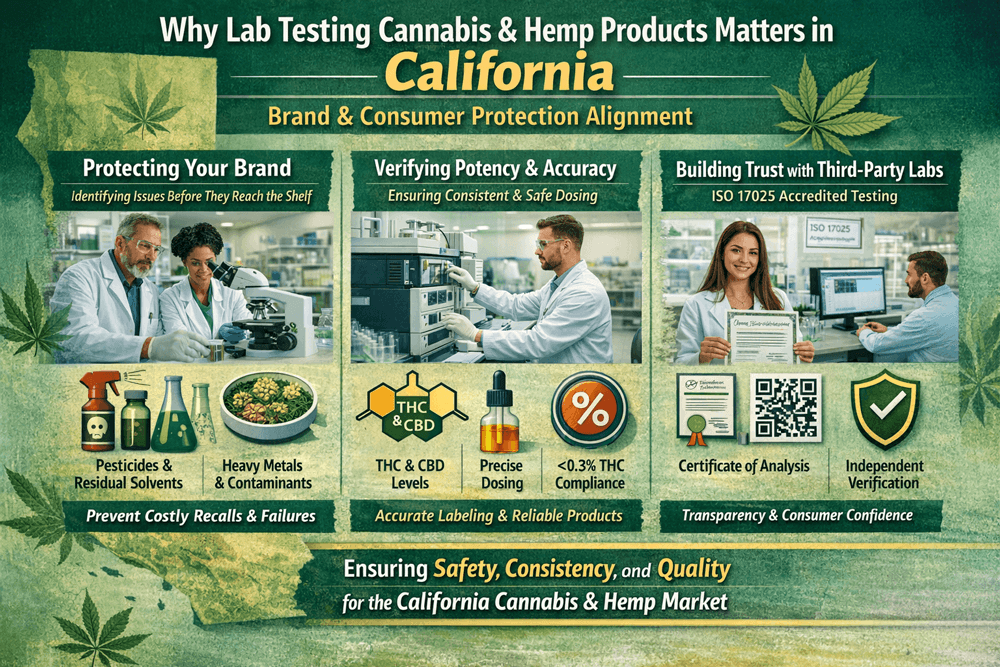
Protecting Your Brand: Identifying Issues Before They Reach the Shelf
Cannabis and hemp are biologically active plants that reflect their environment. Because of this, potential contaminants can be introduced at multiple stages—from cultivation inputs and soil conditions to extraction equipment and packaging materials. Laboratory testing acts as an early warning system, identifying issues before they become costly recalls, failed batches, or damaged retailer relationships.
Pesticides used during cultivation can remain on finished products if not carefully controlled. Certain compounds may even become more hazardous when heated or concentrated. Similarly, extraction processes that rely on solvents require verification that those materials have been fully removed. Residual solvents left unchecked can raise both safety concerns and red flags with distributors.
Heavy metals such as lead, arsenic, and mercury can also appear due to environmental exposure or manufacturing hardware, while microbial contamination can develop during drying, storage, or handling. Comprehensive testing allows brands to catch these risks upstream, adjust processes, and avoid downstream financial and reputational impact.
Verifying Consistency and Label Accuracy: Potency and Dosing Precision
Beyond safety, laboratory analysis provides the critical data necessary for accurate dosing. For medical patients and recreational users alike, consistency drives brand loyalty . A product’s label acts as a contract with the consumer, promising a specific experience. Lab testing verifies this promise by establishing the cannabinoid profile, quantifying levels of THC, CBD, and minor cannabinoids like CBN or CBG – helping brands deliver predictable consumer experiences across batches and product lines. This data becomes especially valuable when scaling production, launching new SKUs, or working with multiple distribution partners.
Accurate quantification is vital for distinguishing between hemp and cannabis legal markets—specifically ensuring hemp products contain less than 0.3% Delta-9 THC. Moreover, it prevents the dangerous variability found in unregulated markets. Studies have indicated that mislabeled products can pose serious risks, particularly to novice users who may inadvertently consume higher-than-anticipated doses. A verified potency test allows consumers to dose responsibly and achieve the desired therapeutic or psychoactive effects without unpredictability.
From a business standpoint, accurate cannabinoid profiles also reduce friction with retailers, who increasingly expect documentation that supports label claims. Clear, compliant, defensible results allow brands to move products through the supply chain with confidence and minimize questions that can slow down purchasing decisions.
Building Trust: The Role of Third-Party Accreditation
Trust in the cannabis industry is manufactured through transparency and independent verification. This is achieved through third-party laboratories that operate independently of the cultivator or manufacturer. To operate in California, these labs must maintain ISO/IEC 17025 accreditation, a rigorous international standard that validates a laboratory’s technical competence and the reliability of its data.
The tangible output of this process is the Certificate of Analysis (COA). This document serves as a “product passport,” detailing every test result—from potency percentages to contaminant “pass/fail” status. Responsible brands make these COAs accessible, often via QR codes on packaging, allowing consumers to trace the product’s safety history. By prioritizing independent verification, the industry builds a framework of accountability where safety claims are backed by empirical science rather than marketing rhetoric.
Conclusion
For cannabis and hemp operators in California, lab testing is a strategic tool that protects your products, your partners, and your reputation. By identifying potential contaminants early, verifying potency and consistency, and leveraging independent validation, testing supports smarter decision-making and stronger brand positioning. As the industry continues to evolve, brands that treat testing as a quality investment—not just a requirement—are better positioned for long-term stability and growth.
